
The care information provided in this section represents the kind of practical advice is available for all the plants in this web site if you subscribe to the monthly customized newsletter Yardener’s Advisor.
Watering
Sufficient water is crucial to roses. They are thirsty plants and need a steady flow of moisture for peak performance. Well-drained soil with lots of organic matter in it, holds moisture available for them, but prevents their roots from standing in soggy soil. Bush roses require about an inch of water a week either from rain or from a watering system. Those planted on very sandy soil or in the South may need even 2 inches of water a week. Water must penetrate 16 to 18 inches to reach the full depth of the roots of mature plants. Because splashing water carries fungal disease spores up to the rose leaves, watering with a drip system laid under a layer of organic mulch is the best way to water. When hand watering, avoid wetting the leaves.
Whatever the method, water rose bushes in the morning so the plants can dry off by evening when fungal diseases thrive.
For more information see file About Watering Equipment.
Fertilizing
One major feeding in the early spring after pruning is adequate for most rose bushes. The most convenient rose fertilizer is a balanced or all-purpose slow-acting granular fertilizer product. You can find fertilizers in the garden center designed specifically for use on roses. See the file Plant Specific Fertilizers in Yardener's Tool Shed.
Sprinkle a cup or so on the soil around the rose bush for the rain to soak in. It will provide steady, consistent nutrition over several weeks. Do not allow it to get on the leaves, the canes and the graft union. Plants in gardens with especially fast-draining sandy soil or those in southern climates may need a second dose of fertilizer about halfway between first flower buds and 8 weeks before expected first frost.
Because rose bushes bloom over a long season, they appreciate supplemental feedings periodically in the summer. Give them a boost to keep them vigorous in the heat by spraying their foliage with a dilute liquid fertilizer every 3 to 4 weeks until 6 weeks before expected first frost. Use a liquid fertilizer at half the strength recommended on the bottle for this foliar spray. Add or substitute diluted seaweed or fish emulsion organic liquid fertilizer to this solution to improve the plant's ability to use the nutrients that are available to it.
Beware of overfertilizing roses. Too much nitrogen promotes excessive foliage growth, making the bushes vulnerable to diseases and insect attack.
For more information see file About Fertilizers.
Consider Plant Growth Activators
There are on the market a growing number of products that will help your plants become healthier, more drought resistant, more disease resistant, and even more insect resistant. These products are generally easy to use and not terribly expensive. If you want to give your plants some oomph, check out New Technology In Plant Growth Activators
Mulching
Mulch is very important for roses. While it keeps weeds down, its primary value is to block moisture evaporation and condition the soil around the bushes. It keeps the soil cooler in the summer when roses are more vulnerable to heat stress. A layer of mulch freshly spread under the bushes in early spring while the plant is still dormant also reduces fungal disease problems, since fungal spores are often deposited on rose leaves by splashing rain bouncing up off infected soil.
Spread two to four inches of some attractive organic material on the soil around the base of each rose bush in the late winter, at least a month before expected last frost. Although the soil around the roses will warm up more slowly, fungal disease problems will be forestalled. Use wood chips, shredded bark, pine needles, cottonseed or cocoa bean hulls, chopped leaves, ground corncobs or peat nuggets for mulch. Keep the mulch about two inches away from the main stem of the bushes.
For more information see file on Using Mulch
Pruning/Grooming Bush Roses
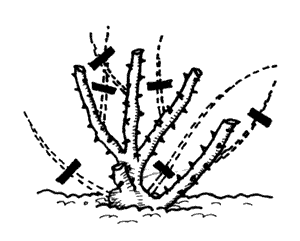
There are several kinds of pruning necessary to keep rose bushes at their peak. Annual pruning is essential to keeping roses healthy and productive. The objective of pruning is to promote an attractive symmetrical bush, to encourage new growth, to remove any diseased, damaged, or dead wood, and to generate larger blooms. In early spring examine rose bushes for pruning needs. Do this just before they break dormancy after the last frost, but not so early that the new growth which follows will be caught by late frost. This means January in warm areas and as late as April in severe winter climates. Time this pruning to when the forsythia is in bloom in your area.
 |
Pre-season
This is the time to cut the rose bushes back fairly dramatically. Sometimes it is necessary to reduce their height by 1/2 or even 2/3rds, depending on how they have come through the winter. Removing dead canes, or main stems, is the first step in pruning any rose. Dead canes are brittle, brown and dried inside and out. Cut or saw them off at their base where they emerge from the crown of the bush. Then remove any dead, winter killed tips on remaining canes by cutting below them where live, greenish tissue begins. Cut at the nearest healthy, little bud eye, a small bulge on the stem with a tiny `eye' and a horizontal crease below. After dormancy or if stimulated by pruning, the bud eye will develop into a new shoot.
 |
Bypass pruners are usually the type you need for pruning roses.
For some quality options click here.
Heavy duty gardening gloves are a must for working with roses
Garden Gloves
There are a large number of glove companies making garden gloves for use with pruning roses.
Here is are some options:
Magid TE194T-L Terra Collection Professional Rose Gardening Gloves - Mens Large
- Puncture-resistant, synthetic leather padded palm and reinforced fingertips
- Provides what professional rose gardeners need most � strength, durability and comfort
- Elbow-length gauntlet cuff protects forearms from cuts and scratches
- Knuckle guard provides added protection from thorny plants
- Form fitting spandex back for maximum comfort
With a puncture-resistant, synthetic leather padded palm and reinforced fingertips, this rose glove provides what professional rose gardeners need most strength, durability and comfort. The elbow-length gauntlet cuff protects forearms from cuts and scratches, and the knuckle guard provides added protection from thorny plants. Form fitting spandex back for maximum comfort.
Deluxe Women's Rose Pros Garden Gloves (Large)
- Premium goatskin with superb thorn resistence
- Elbow high cuffs keep your arms protected when you are reaching in.
- These are sized especially for women so they feel natural.
- Besides roses they are helpful for bushes, brush and cactus.
Women's Heavy Duty Gauntlet Garden Glove TGL 109
- Heavy duty gauntlets are made from hard-wearing leather with a tough leather palm.
- The extra long, reinforced safety cuff, on these gloves fully protects wrists.
- Offers great protection while working in the garden.
- Great thorn protection!
-
- A customer review
- I bought these gloves for my sister's birthday. She does a lot of bush and tree trimming and always has scratches on her lower arms. These gloves are heavy duty enough to last her many many years of garden work. They are of very good quality and the shipping was fast even though they did not come direct from Amazon. I would have rated them a 5 if they were a tad bit longer.
Maintenance
During the growing season it may be necessary to occasionally prune rose bushes to maintain their appearance. Some older canes die, others become damaged or diseased. Cut these from the shrub promptly.
Deadheading
Deadheading, cutting spent blossoms from the stems, encourages bushes to produce new blooms. Cutting off faded blossoms diverts nutrients and energy from seed production back into more leaves and flower buds. It also forestalls the development of disease in the spent blossoms. When deadheading, snip the bloom and its stem back to where the leaf stalks produce five leaves. Cut the stem just above the leaf stalk at a 45° angle with sharp, clean pruners.
Try to avoid removing any more leaves than necessary. They are the bush's food factory and are essential to the regrowth of new leaves and blossoms. At the same time, do not simply snip off the blossoms and no leaves, because that favors the smaller leaf stems or buds with fewer than 5 leaves and they will not turn into as vigorous new growth as the 5-leafed stem will.
Stop removing faded flowers in late summer. This allows seeds and the fruit of the rose, called rose hips, to develop and mature. Leaving faded flowers on canes in late summer discourages the development of new growth that is susceptible to frost. It makes rose plants more winter hardy.
Disbudding
Serious rose growers pinch off certain new buds on their rose bushes in the spring to direct new growth and promote development of large flowers throughout the season. As growth begins, they pinch between thumb and forefinger those tiny buds that grow strongly toward the center of the plant. Where 3 buds begin to grow from 1 leaf node, they pinch off the weaker side buds to direct the plant's energy into development of the main bud. Removing side buds concentrates the plant's growing energy into the central flower. This causes the flower to become larger.
Renovation
Neglected rose bushes may need extensive renovation to recover their beauty and health. Older plants are quite tolerant of renovation. Most can be cut to the ground and recover beautifully if watered and fertilized. The recommended renovation process is a little gentler. At the time of winter pruning, remove all canes except the youngest 3 or 4 canes. Use a pruning saw and cut the canes down at their base. Do not leave stumps. Remove all weak twigs.
For more information see files on Pruning Shrubs and choosing pruners for rose growers; click here
Winter Protection
A thorough annual fall cleanup is essential to keep roses healthy. Remove any leaves that remain on the plant, and rake up and discard all old leaves, prunings, and any old mulch on the ground or around the bases of the bushes. This is a critical step because insect eggs and disease spores overwinter on fallen rose leaves and debris. After cleaning up the bed, water the soil thoroughly, because the roots remain active long after winter begins. Spread a fresh layer of mulch over the root zone of each rose bush. In cold climates mound mulch and/or soil up against the stems, covering the crown and swollen graft site, if present, on the bush.
Winter protection must be sufficient to prevent the temperature around the plant from going below a certain point, to insulate the rosebush from the alternate freezing and thawing of soil which disturbs plant roots, and to prevent the canes from whipping about and causing roots to loosen. It should keep roses cold enough so they are completely dormant at a fairly constant temperature--ideally in the 15° to 25°F. range. Begin protective measures just before hard freezing weather, which usually occurs about a month or two after the first frost. These measures may be:
Where temperatures do not go below 20°F
Spray the plants with an anti-transpirant spray to minimize water loss during the cooler months. Shield rose bushes located in a site that is exposed to the drying winter winds with a permanent fence or hedge, leaving 10 feet between the fence and rosebushes. Also, wrap or surround your bushes with burlap or white, polyspun garden fleece that allows air to get to the plant but protects it from desiccation by the wind.
Where temperatures (drop)to 10° or so for 2 weeks or more at a time
Mound the base of each rose bush with fresh, loose soil or compost that drains well. After the first hard frost, mound the soil to a depth of 6 to 8 inches around the plants. Prune the bushes back only enough to prevent the canes from whipping about the wind and to allow them to fit under a protective burlap or agricultural fleece windbreak. Spray the bushes with a anti-transpirant spray, and then add 8 to 10 inches of chopped leaves, straw, or other organic mulch over the entire bed.
Where temperatures dip to -15°F. or lower
Enclose the entire rose bush, soil mound, and loose mulch and all in an over-turned peach basket, a tar paper cone, or some commercially available rose cap or cone designed for that protective purpose. Gradually begin to remove soil mounds as they thaw, over a period of two to three weeks in the spring. Remove the mounded material carefully to avoid breaking any growth that may have begun under the mound. The tender growth underneath that mound can be easily killed by even a light freeze, so keep some straw or white, polyspun garden fleece handy to cover plants in the event of a late frost.
For more information see file on Winter Protection For Plants and Plant Protection Supplies.
