
Hand Pruners
For normal tree maintenance, yardeners really need only two tools: a pair of hand pruners for clipping branches under an inch in diameter and a pair of long handled loppers for branches from 1 to 2 inches thick. There are two basic types of hand pruners.
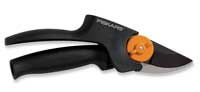 |
Bypass hand pruners work like scissors, having a sharpened cutting blade that slides past a lower hooked blade. These pruners make straight, clean, close cuts, but the blades can get misaligned if you try to use the tool to cut too large a branch. Bypass pruners come in two styles, with straight or curved blades.
Anvil pruners have a straight cutting blade that strikes a flattened bottom piece. They are not likely to get out of alignment, but they tend to twist during angled cuts, and they can crush the undersides of branches, especially if the cutting blade is dull. On both types, check that the blades are aligned along their entire length before using. Some anvil pruners have gearing or ratchet action to facilitate cutting larger branches.
Look for tools with comfortable hand grips and spring action that won’t fall apart with repeated use. There are long-handled models available, and you can even get them fitted with long-reach extensions that allow a person to garden from a wheelchair. Hand pruners are usually sold according to the largest size branch they can cut, such as ½-inch, ¾-inch, or 5/8-inch. If the branch is too large to comfortably clip with hand pruners, you will need more leverage, so use loppers.
Click here for more information about Choosing Pruning Tools
Loppers and Pole Pruners
Lopping shears, or loppers, may also be either bypass or anvil design. They feature larger blades and longer handles than hand pruners, offering more leverage for cutting branches up to 3 inches in diameter. They may employ ratchets or gears to increase leverage, or have a compound action design using several pivots, like a bolt cutter. Choose loppers with steel, ash or hickory handles bolted or riveted to the blades. Always open the blades wide and position the branch in the angle close to the pivot when starting the cut.
Lever-action pole pruners will cut high branches up to the same diameters as loppers do. NEVER use metal-handled pole pruners if you are working near power lines. They sometimes have saws on them also, for sawing slightly higher branches while standing safely on the ground. The same type of saw as those used by hand, it is useful for removing a branch that is too large for loppers.
Pruning Saws
To cut branches larger than 3 or 4 inches use a pruning saw. For all but heavy branches, a curved saw with a 9- to 15-inch-long blade with medium-coarse teeth is adequate. For larger limbs, a D-grip straight pruning saw, preferably with a raker as well as cutting teeth that clean sawdust out as they cut, is best.
The fineness of a saw’s cutting edge is measured in points, or teeth, per inch. An 8-point saw is for delicate, close work on small shrubs and trees. Average saws are about 5-1/2 to 6 points, while 4½ point saws are good for fairly heavy branches. Avoid folding saws, ones with oddly curved, hard-to-hold handles. Bow saws, which are fine for sawing up limbs that are already cut, are useless where branches are very close together.
Chainsaws
While trained professional arborists typically use chainsaws to cut limbs from trees, homeowners usually—and wisely—have used an electric or gasoline powered chainsaw only for cutting up branches for firewood after they have been cut from the tree. Needless to say, they are not appropriate for thinning out small branches or twigs from young trees.
A new generation of lightweight, residential scale chainsaws is now available to homeowners. These chainsaws are appropriate for use as a tool of last resort for certain pruning jobs by relatively inexperienced yardeners. They can cut from any angle, even upside down, and are just the thing for removing large dead branches and cutting them up for firewood. Look for safety features such as a chain brake, which stops the saw automatically if it jams, and a cutting guide that stabilizes the saw at the cut.
Click here for more information on Choosing a Chainsaw
Keeping Tools Sharp
To make pruning jobs easier and reduce the risk of damaging the tree, keep your pruning tools sharp. A dull pair of pruners will pinch a stem or tear a branch rather than cut it, leaving a damaged end that is vulnerable to insects, borers, and diseases. See examples in the file Garden Tool Sharpening Tools
If you can’t have your pruning tools sharpened, replace them with new, sharp blades wherever possible. If you have a chainsaw, check to see if it has an automatic sharpening feature, or get a chainsaw sharpening kit.
