
 |
Trees defoliated, brown egg cases appear on trunk
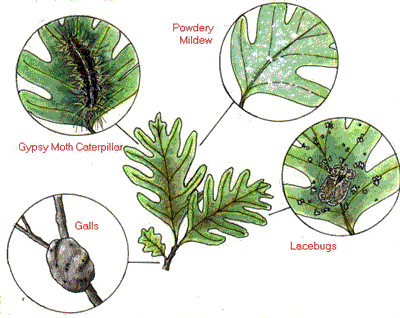
Larvae Of Gypsy Moths - Oaks are the favorite food of gypsy moth larvae. These caterpillars are about 2½ inches long with 5 pairs of blue spots and 6 pairs of red spots along their backs. They can completely defoliate a mature tree in 2 weeks. The tree may die after repeated defoliations.
The adult moths do not fly. They lay egg masses covered with velvety, buff-colored hairs, containing 75 to 1,000 eggs. The eggs are visible in June or July on the bark of trees, on stone walls, woodpiles, or even on your yard furniture. They sit dormant over the winter until next spring, when the caterpillars hatch and head up into the foliage to feed. For complete information see the file Controlling The Gypsy Moth Caterpillar
Roots Growing Above Soil Surface
Pin Oak Trees are often found with some of their roots growing above the surface of the soil. This is usually because they are growing in compacted soils. For solutions see the file Dealing With Surface Tree Roots
Irregular tan or brown spots on leaves at veins, expand until leaves die, sometimes sunken spots on leaves
Anthracnose, A Fungal Disease - This fungus disease causes moist, sunken spots with fruiting bodies in the center on the leaves of some Oaks. The leaf spots may run together, resembling a blotch or blight. The dead areas follow the veins or are bounded by larger veins. Sometimes terminal stem shoots are infected back to several inches below the buds. Pustules containing pinkish spores appear. Dieback and defoliation may occur in severe cases. Anthracnose is not life-threatening to large, established trees. For more information see the file on Controlling Fungal Disease
Swellings and growths on twigs and leaves
Gall Insects - Twigs, leaves, and even the acorns of Oaks are commonly disfigured by odd shaped growths called galls. These buttons, cones, bullets, balls, and blobs are caused by minute gall wasps or flies which lay their eggs in the plant tissue. When tiny grubs hatch out, they secrete powerful plant growth substances that force the tree to form the gall around the developing insect, which lives on nutrients from the abnormal growth. They are rarely a threat to the trees they infect. Usually by the time a gall is obvious, it is too late to do anything about it. Remove affected leaves
and branches and trash them. Try collecting some of the galls and storing them in a plastic bag in a shady place and watch for when the adult insects emerge. Then spray the affected tree if it not too large. Synthetic Insecticides for Trees and Shrubs
Leaves stippled, yellowing or bronze, dry out and (drop)may be webbing visible, sometimes galls form on leaves
Oak Mites - Oak mites are about 1/50 inch long, barely visible to the unaided eye. Resembling tiny spiders, they have four pairs of legs, piercing-sucking mouth parts, and very compact bodies. They may be yellow, green, red or brown. If the top surfaces of the lower leaves on the Oak tree are stippled with small yellow dots or red spots, it is likely that mites are the cause. Look for fine webbing over leaves, their stalks and adjacent stems. For more information see the file on Controlling Mites
Leaves turn bronze, wilt, drop
Oak Wilt, A Fungal Disease -
Most Oaks are susceptible to this systemic fungal disease, although members of the Red Oak group are hit harder than White Oaks. It is spread mostly by insects such as beetles or borers, by man, or even by squirrels. It enters the tree through wounds in the bark. Often it is inadvertently carried by arborists or foresters on their tools. Trees are most vulnerable during their early spring growth period as they develop new wood. The fungus causes the leaves to turn a sickly bronze color. Soon they wilt and eventually fall off.
This disease is prevalent in the north-central, mid-Atlantic and mid-Western regions of the United States. There is, as yet, no reliable treatment. Researchers are working on a promising fungicide.
Dealing With Oak Wilt
Of special concern these days is anyone owning one or more oak trees. Usually oak trees need no pruning except when they are damaged in a storm. The very serious concern is to do any repairs to storm damage on your oaks before April 1st. If an oak is pruned even just a little bit from April through July or even August, it is exposed to the very serious threat of a disease called “oak wilt”.
This fungal disease very often occurs in oaks if they have been pruned in the warm months. The stakes are very high. Any oak infected by oak wilt will die in one or two months. It is a disease found in every county in Michigan and is easily as serious as the Dutch elm disease that wiped out most of America’s elm trees in the last century.
The red oak family is the most vulnerable to oak wilt. That includes red oak, scarlet oak, black oak, and pin oak. The white oak family is a little less vulnerable but can still contract this disease. The white oaks include white oak, swamp oak, and burr oak. If any of these trees are in your yard and are in good health, they are not likely to have any problems with oak wilt. The fungus does not enter a tree with no damage. A good reason to have your oaks checked by a professional arborist every three or four years is to ensure ongoing health of those very valuable shade trees.
Leaves coated with white powder
Powdery Mildew, A Fungal Disease - Powdery mildew caused by various fungi attacks Oaks, covering their leaves and growing tips with whitish patches. This disease is rarely fatal in established trees, but it mars their appearance. For more information see the file on Controlling Fungal Disease
