
A healthy soil is home to an incredible number of creatures. The collection of soil critters from the tiniest microbe all the way up through beneficial mites to the mighty earthworm is called the “Soil Food Web”. "Soil Food Web" is a term that has recently been created to describe those thousands of species of critters that inhabit a healthy soil ecology.
When these underground citizens are in sufficient numbers in the soil, they prevent compaction, improve soil drainage, control plant disease, and most important they make nutrients and water readily available to plants. We can’t have healthy plants unless we have healthy soil, and that is not possible without sufficient members of the soil food web in residence.
What is critical to understand about this community of creatures is that they are all related to each other. When part of the food web is destroyed by a pesticide for example, the system for maintaining a healthy soil comes to a stop.
It turns out that the earthworm is the main caterer for the soil food web. It pulls much of the organic matter needed by the members of the web down from the surface into the soil. The whole soil system depends on the availability of that organic matter on the soil’s surface, so the earthworm has something to pull down for everyone’s lunch.
For ten million years, Mother Nature with her forests and the prairies offered the soil food web an annual dose of organic matter in the form of autumn leaves and dead grass. Unfortunately, that ready source is not available to our lawns and gardens. We need to find a way to make organic material available to the earthworms over our entire home landscape; under the trees and shrubs, on the lawns, and in the gardens.
If you want to have a healthy soil under your turf, you need a healthy soil food web. You can feed it or you can kill it. Most people are killing it, guaranteeing their growing grass in dead soil.
Our recommendation is to feed the soil food web and do everything you can to avoid harming it.
WHY ENCOURAGE EARTHWORM POPULATIONS IN OUR LAWN SOIL?
While they do lots of good things for soil structure in terms of creating air spaces, earthworms' greatest role is as a major producer of natural fertilizer. As they go about their business in the soil under your lawn they excrete their weight in castings every day. Worm castings are an absolutely wonderful fertilizer, providing nutrients in a form grass plants can use. In a 1000 sq. ft. area for example, at a density of only five worms per cubic foot (considered a low population), your earthworms will give you over 150 pounds--about 1/3 pound per worm--of top-grade fertilizer during each growing season. This fertilizer contains the key plant nutrients--nitrogen, phosphorus, and potassium--plus many of the essential micronutrients plants need to grow and remain healthy. Dead earthworms are also very rich in nitrogen. Earthworm castings offer the equivalent of about ½ to1 pound of nitrogen per 1000 sq. ft. per year, or over 25% of the total fertilizer needs of the turfgrass.
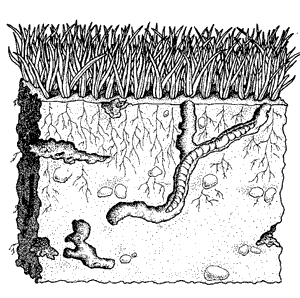 |
Worms not only produce this valuable fertilizer, they also spread it evenly throughout the top 12 inches of the soil. In many cases they travel much deeper, sometimes as far down as 6 feet. A well-managed soil rich in organic matter can easily support 25 worms per cubic foot, which, in that same 1000-square-foot area, means at least 800 pounds of fertilizer. That amounts to a lot more than 2 pounds of nitrogen for each 1000 square foot, all courtesy of Mother Nature.
If you decide to take advantage of the work that earthworms do in your lawn, that has implications as to whether you choose quick acting or slow acting fertilizer. Quick acting nitrogen fertilizer can make the soil more acidic. Research shows that when enough fertilizer is added to a lawn to cause the soil to become more acidic, thatch accumulation goes up and earthworm populations go down, every time. It follows that if you are trying to attract worms to help you with fertilizing the lawn, then you will avoid routine use of quick-acting fertilizers. These products do have their place, but not as main meals for turf where earthworms are invited guests.
The real key to keeping your worm population high is adding lots of organic material to your lawn every single year without fail. The process is described in the lawn grass mulching section; click here to go there.
WHY WE ENCOURAGE BENEFICIAL MICROBES IN LAWN'S SOIL
A soil that contains the desirable 3% to 5% organic matter in the top 8 to 12 inches will have a very active microbial population, assuming there is sufficient air and water available (the soil must not be seriously compacted).
Those microbes do many good things including decompose thatch, control diseases and pest insects, and produce nutrients for consumption by the grass plants. One of those nutrients is nitrogen. A healthy microbial population working in a soil with sufficient organic matter will produce ½ to 1 pound of nitrogen per 1000 square feet of lawn each season, representing about 25% of your lawn's nitrogen needs. As with the earthworms, if you choose to use a quick acting nitrogen lawn fertilizer, you will make the soil more acid and greatly reduce the population of these valuable microbes, eliminating their contribution of nitrogen. Then you have to make up the difference.
As with the earthworms, the key to having a healthy population of microbes is to add organic material to your lawn’s soil year in and year out. The Lawn Grass Mulching section tells you how to do that. Click here.
Questions and Answers
Q - Where can I buy beneficial soil bacteria?
A - You can buy a product called Plant Growth Activator. It contains billions of beneficial soil microbes. English Gardens has them. Then follow the instructions.
