
Choosing the Best Fertilizer
 |
Always use granular fertilizer with a significant proportion of its nitrogen in slow-acting form (WIN, or water-insoluble) to deliver basic nutrition to turfgrass. It provides steady, constant sustenance over an extended period, minimizing the time you spend fertilizing. Organic fertilizers whose nutrients are derived from plant and animal sources are always slow-acting. Knowing how to Fertilize is an important consideration when caring for turfgrass.
 |
Liquid fertilizers, either granular or powders to be mixed in water, are almost always quick-acting. Because their nitrogen dissolves in water, it is absorbed so rapidly by grass plants that repeat fertilization is necessary many times over the season. The strong doses of nitrogen it delivers each time may stress grass and acidify the soil somewhat, irritating soil organisms.
Store leftover granular fertilizer in an airtight bag or container. If you have only a few pounds left, use it on other parts of your property. Slow-acting lawn fertilizer is suitable for planting beds and under shrubs, hedges, and trees. Sprinkle it lightly to get good coverage around the yard. The rain will soak it into the soil.
Choosing the Best Spreader
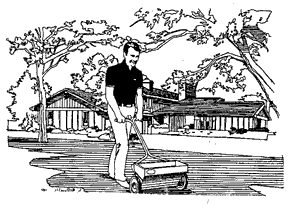 |
Spreading granular fertilizer by casting handfuls over the turf is appropriate and easy for small lawns (under 1000 square feet). However, it is very difficult to get a uniform application this way. Use either a drop or rotary (spinner or cyclone) spreader for large lawns. The drop spreader is cheaper, but the rotary spreader is more effective in getting uniform coverage. With the rotary action the throw pattern of the fertilizer "feathers" out along the edges so that the margins of each pass blend together uniformly.
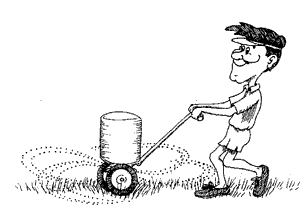 |
They are available in hand-held (good for under 5000 square feet) models or on wheels.
Never store leftover granular fertilizer in your spreader. Fertilizer absorbs moisture from the air and cakes up. Then it promotes deterioration from chemical reactions with the metal of the spreader. If your spreader is caked with fertilizer, clean it out thoroughly. Use water if necessary, but do not put any more fertilizer into the spreader until the interior is absolutely dry. Use some penetrating oil on the moving levers and parts periodically to keep them operating smoothly.
See Examples of Spreaders in Yardener's Tool Shed.
Fertilizing Techniques
When spreading granular lawn fertilizer there are two problems -- using too much fertilizer and missing spots that become embarrassingly obvious later when the rest of the lawn turns green. Mow the lawn first, so you can see the distribution pattern easier.
All spreaders have numbered devices to control the flow of the granules from the spreader as you push it. They are sometimes difficult to use. When in doubt, adjust the setting by sight. Correctly dispersed, the density of fertilizer granules should resemble the decorative sugar sprinkles on a cookie. There is more bare space than granules. Test the dispersal rate of your spreader on bare soil or on a paved surface. When in doubt, spread less rather than more fertilizer.
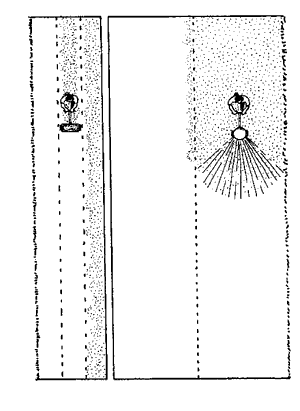
Drop Spreader on the left and Rotary Spreader on the right
To avoid making obvious "fertilizer stripes" in the lawn with a drop spreader divide the fertilizer supply in half and set the spreader to apply at one-half the recommended rate. Then cover the lawn twice, pacing the pattern of the second application perpendicular to the first one. While it is not necessary with a rotary spreader, the technique of spreading half, and then the other half of the fertilizer in different directions is still a good idea. It takes more time, but the coverage is much more uniform.
Watering in Fertilizer
It is not essential to water in slow-acting fertilizer, but it does not hurt. It ensures that the fertilizer begins working right away. Otherwise, the next rain will soak it in. However, quick-acting granular fertilizer must be watered in immediately after spreading to prevent it from burning the grass plants. Watering also triggers the release of the nitrogen right away, since that type of fertilizer is water soluble. Proper absorption depends on understanding how to fertilize.
