
Keeping Grass Green
Most turf grasses grown as ornamental lawns in the US are descended from tough grasses that grew on prairies or savannahs in other parts of the world. In their natural habitats they are accustomed to periods of generous moisture followed inevitably by periods of drought. Accordingly they adapt by growing during the rainy season and then by browning and going dormant to survive the dry seasons. This is what they do in residential landscapes too.
 |
However, homeowners want lawns to stay green throughout the growing season, usually the dry season. Therefore, to keep turf grass green and to maintain young grass seedlings in a new lawn, watering the lawn when rainfall is sparse is essential. So important is regular watering to maintain green lawns, that permanently installed pop-up sprinkler systems are common in residential landscapes in the hot southern regions of the US.
Watering Correctly
In this time of increasingly limited supplies of fresh water and heightened concern about the responsible use of our natural resources, the issue of watering lawns has become critically important.
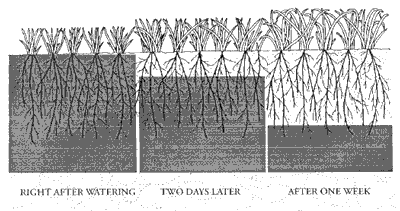 |
Research indicates that those homeowners who water their lawns in an effort to maintain a lush green turf during the summer months tend to water ineffectively, typically wasting water by watering too often or, paradoxically, watering insufficiently each time. They also waste water by failing to build good, moisture-retaining soil for their grass plants, so they can develop deep roots. Grass with deep roots is more self-reliant in drought because it can access soil moisture deep in the soil and go long periods without needing supplemental watering.
Northern lawns need light, frequent watering which is a new idea
Until I moved to Michigan, I was confident that the basic rule for watering the lawn was to water the lawn infrequently and deeply in spring, summer and fall when the grass needs water. In addition, the conventional wisdom was to give the grass an inch of water a week in the spring and fall, and kick it up to 2 inches of water a week in July and August either from us or Mother Nature.
When I checked Michigan State’s Extension Bulletin on irrigating the lawn, I found a completely different recommendation from tradition. They say “light, frequent applications of water are much more productive than heavy applications once a week.” I talked with several experts in the MSU crop and soil sciences department and found out why their watering instructions are so completely different from the traditional recommendations.
Roots Get Shorter In Heat Of Summer
It turns out that Kentucky bluegrass and perennial ryegrass, the two most common species used in Michigan, experience in the summer a significant reduction in their root mass because of the stress of heat. In spring, they might have roots 6 to 8 inches deep, but by August, those same roots will recede to a depth of only 2, maybe 3 inches. In late August or early September, the roots again expand so by November they will be back to 6 to 8 inches deep.
A half-inch of water will penetrate the soil down to about 3 inches. If you want to give your plants a total of 2 inches in July, you would need to water four times a week, a half-inch at a time, to give the grass plants 2 inches for summer needs. So MSU suggests the frequent and shallow watering technique is best because it gives the plants the water they need in a manner that allows them to get the whole 2 inches over the period of a week. It is the most efficient way to give the lawn the water it needs in the summer.
If You Have Good Soil, Old Rules Prevail
It seems to me that the traditional advice of watering infrequently and deeply still works best for spring and fall but only if you have good soil and your turf roots are in fact down there 6 to 8 inches.
With Lousy Soil Use New Rules
Unfortunately, most of us don’t have good soil. We are growing grass in lousy, compacted soil, and our grass roots are down only 2 inches for the whole season because they can’t break through that layer of compaction.
So it appears that if we have a lawn with lousy compacted soil, we should still use the MSU model in the spring and the fall as well as in the summer; if the grass needs water, then water frequently and lightly or a half-inch at a time.
