
About Roosting Boxes
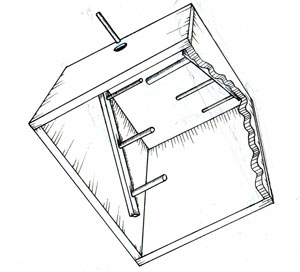
Roosting boxes are roofed, hollow boxes outfitted with pegged perches along their interior walls. Unlike birdhouses, which accommodate a nest, these boxes are only intended to provide shelter from severe weather for cavity-nesting songbirds. They are accustomed to taking refuge in a protective hole in an old tree made by woodpeckers or tree injury. These days suitable protective hollow trees are removed from populated areas because they are unsightly, unsafe, or a the bulldozer’s path.
In cold weather songbirds eat constantly during daylight hours to sustain their energy. At night they expend a lot of that energy fluffing their feathers and shivering to keep warm until dawn. Often thick evergreens and other vegetation fail to provide enough protection for birds trying to get through the night. Though they crowd together for warmth, many birds become seriously dehydrated and freeze to death. Mortality is typically highest among the little birds such as chickadees and titmice. In a very bad snow storm with below freezing temperatures for more than a day or two, as much as 50% of smaller songbirds can perish. This is a real problem and only yardeners can really help. So we strongly recommend that you buy or build a roosting box and mount it on a tree on your property to help resident birds.
See Yardener’s Tool Shed for examples of roosting boxes available commercially – Click Here
Sheltering Single and Multiple Tenants
A roosting box is a weathertight box with an entrance hole set low and one or more perches mounted inside. Unlike birdhouses they do not have vents or drainage holes, so the warm air generated by the roosting birds is retained. Boxes can vary in size, depending on how large the number of birds you want to accommodate.
Some birds roost together in small groups to share body heat. These include chickadees, nuthatches, titmice, wrens, bluebirds, and certain small woodpeckers. In one documented case, 31 winter wrens were observed to fit inside an unused nesting box only 6 inches square! Larger birds, such as flickers, screech owls, and sparrow hawks, like to roost alone, so a box intended for them can be smaller and needs only a single perch.
Building Roosting Boxes
 |
Roosting boxes ready for mounting are usually available where bird feeding supplies are sold.
See Yardener’s Tool Shed for examples of roosting boxes available commercially – Click Here.
Roosting boxes are also is easy to build. A 10 inch by 1 inch pine board 12 feet long is sufficient for one box. Perches for the interior are ¼ or 3/8 inch dowels. You will need a hand drill, a saw, a jigsaw (or hole saw), and a screwdriver.
Roosting Box Design
The size of the entrance hole determines which kinds of birds can enter the roosting box for protection. A hole cut 1½ inches in diameter admits only tiny birds, discouraging pushy sparrows and starlings. A 2 inch hole welcomes sparrows and starlings, while a 3-inch hole accommodates flickers and screech owls if they are in your area.
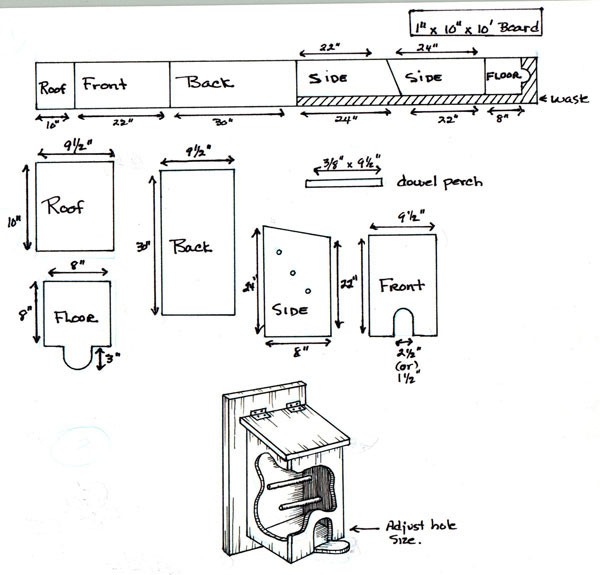 |
Stagger perches on the inside at various levels so that no bird is perched directly above another bird. Hinge the top or front of the roosting box for easy access for cleaning in the late spring. Check the box again in the late fall to remove any wasp nests that might have developed. It’s a good idea to seal the roosting box over the summer keep out destructive squirrels.
A coat of exterior, dark colored paint on the outside of a roosting box is not essential, but it is helpful. It encourages the absorption and retention of daytime heat. Also a coat of varnish on exterior surfaces will extend the life of the box. Renew the coat of varnish each year. As with birdhouses though, never varnish or paint the inside of the roosting box; the birds won’t use it.
Mount roosting boxes 8 to 15 feet off the ground in trees or on buildings. A good place is in a mature pine tree where the foliage buffers the wind of the winter storms. It is best to mount the box in a spot that is easy to reach for cleaning. In any case, orient the entrance toward the south, away from prevailing winter winds. Be sure to locate it where accumulations of bird droppings will not be a problem.

Buying Roosting Boxes
There are six Wild Birds Unlimited stores in metro Detroit offering a number of roosting boxes ranging from $10 to $45 (www.wildbirdsunlimited). Duncraft offers an interesting box that allows you to flip the front wall so the hole is high during the season and used as a nesting box or flip it so the hole is low make the device a roosting box in the winter (www.duncraft.com, $45).
Building Roosting Boxes
If you are just a little bit handy, roosting boxes are easy to build. I have complete instructions with illustrations on my web site at www.yardener.com, placing “roosting box” in the search window. A 10 inch by 1 inch pine board 12 feet long is sufficient for one box. Perches for the interior are ¼ or 3/8 inch dowels. You will need a hand drill, a saw, a jigsaw (or hole saw), and a screwdriver.
It is a good idea, but not essential, to add a coat of exterior, dark colored paint on the outside of a roosting box to encourage the absorption and retention of daytime heat. Also a coat of varnish on exterior surfaces will extend the life of the box. Renew the coat of varnish each year. As with birdhouses though, never varnish or paint the inside of the roosting box; the birds won’t use it.
Mount roosting boxes 8 to 15 feet off the ground in trees or on buildings. A good place is in a mature pine tree where the foliage buffers the wind of the winter storms. It is best to mount the box in a spot that is easy to reach for cleaning.
In any case, orient the entrance toward the south, away from prevailing winter winds. Be sure to locate it where accumulations of bird droppings will not be a problem.
Turn Birdhouses Into Roosting Boxes
I got a wonderful tip from Bill Thompson, editor of the wonderful Bird Watcher’s Digest (www.birdwatchersdigest.com $20 for year’s subscription). You can make every bird house into a roosting box by covering the ventilation holes on the sides near the top of the box with that gray clay-like corded material called Mortite; used to seal drafty windows for winter (available in any hardware store); then remove it in the spring.
