
 |
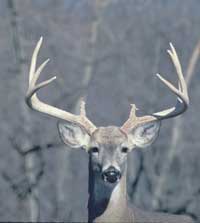
Increasingly deer are at the top of homeowners' lists of most troublesome animal pests. Development of residential housing sites in suburban and rural areas has made severe inroads in available natural habitat for wildlife of all kinds. In many areas of the country deer which are deprived of their traditional habitat are devouring local landscape and garden plantings as fast as they are planted.
Take Note: It is important to discourage deer immediately, because it is much harder to evict them once they have established feeding habits that include your property.
Quick Summary Of Options
Deer hunting season is upon us, but those of us living in southern Michigan will not get much respite from deer damage to our landscape plants. Because 90 percent of the land in southern Michigan is privately owned and more densely populated, the number of deer harvested in this area will likely not even account for the number of deer born here in the past year.
The number of deer per square mile will continue to rise as it has each year for the last 15 years. So if you had any problem with deer damage last year, you are very likely to the same experience in 2010. Here are some deer control ideas:

Plastic Deer Fencing Material
Deer fence. There is only one deer control product that guarantees protection from deer damage. That is an 8-foot-tall plastic-netting deer fence professionally installed. They are very expensive, and you need to establish gates, including one on the driveway. For more information go to www.bennersgardens.com.
If you do not have a deer fence, then you will need a combination of deer-control products to have any hope for success. Here is a list of the deer-related products.
Electric fence. The battery- or solar-powered electric fence kits are effective in protecting a vegetable garden or flower garden. To learn more, go to www.fishock.com.
Repellents. Applied properly and frequently enough, repellents can protect a single plant or group of plants from attack by deer. They are not practical for protecting the whole yard or even a large garden. We have tried many deer repellents and have found Plantskydd to be the most reliable and effective.
Battery-powered deer zappers. This is a device on a stake. On the top are small wires that give a deer a good electric shock on his nose. It has a strong pheromone lure inside the hot wires to cause the deer to stick his nose down to the zapper. One or two of these products are effective in protecting an individual plant you want to save. The battery works for eight months. Learn more at www.wirelessdeerfence.com.
Scarecrow spritzer. Attached to your garden hose, this device on a stake has a motion detector. When it spots motion, it spritzes water out 30 feet. The noise of the sprinkler and the contact from the water will definitely cause a deer to go away. It's effective for a modest garden or a flower bed. Check out www.scatmat.com.
Fishing line. If your yard is surrounded by trees, you can string 30-pound test monofilament fishing line around the periphery, secured at about 36 to 40 inches off the ground. A deer can't see it, but when it touches it, it jumps back and goes someplace else. The line can't protect against deer coming in by the driveway or other entrances.
Frequently Asked Deer Questions
Is an electric fence dangerous for children? Answer - it will not hurt them but it will be uncomfortable enough so they are not likely to touch the fence again. See file on electric fences
Commentary And Opionion
Deer herds could devastate Oakland County's landscape
Over the past six months, I have watched with great interest the events that have unraveled in Rochester Hills, home of more than 1,000 deer as of last fall according to their naturalist. In November, the community got permission to cull 200 deer from that herd using sharpshooters from the Oakland County Sheriff's Office.
In February, the culling operation was stopped because only 16 deer had been killed and community opposition was growing. So logically, those deeply concerned citizens were calmed down by the creation of a committee -- a deer management committee that will report during the summer with recommendations.
What a mess! After "studying" the problem for over a year, there appears to be no one in Rochester Hills that understands the real problem. The published issue of concern is the number of car accidents created by deer. Car crashes are bad, but that is not what should be keeping the folks in Rochester Hills awake at night. The problem will be the systematic destruction of the ecological health of the community, and the deer will be the masters of that destruction.
Because a happy doe will usually have two babies a year, while the sheriff's folks were trying to kill 200 deer, the number of the herd would still have risen to be more than 1,500 deer -- just in time for the deer management report. No matter what the report says, in 2010 the number of very large furry plant harvesters will be well more over 2,000. Since there will unlikely be any acceptable method for reducing deer numbers in the next five years, there is no reason not to assume that the deer population in this community will exceed 3,500 deer.
Now here is the sobering part. A mature deer will consume five to seven pounds of organic matter every day. They eat only stuff that grows. Last year, those 1,000 deer were chomping more than 5,000 pounds of plants every day.
The reality of this devastation will begin to become very obvious when the population of deer in Rochester Hills exceeds 3,000. Those deer will need to be consuming 15,000 pounds of plant materials each day, and that much food will not be there. By then, the understory of any area of woods will be bare. No new trees will be growing in the woods in Rochester Hills for many decades.
Landscapes around all those lovely homes in this upper-income community will be denuded of all shrubs, flowers and ground covers. When deer are starving, and the deer in Rochester Hills will be starving, they will eat any plant they can find. So forget about that list of landscape plants that deer are supposed to avoid.
By the way, in the next five or six years many other suburban communities in southern Michigan will have the same devastating experience I've predicted for Rochester Hills. I feel sorry for the deer management committees of these communities.
Mystery of the missing acorns in 2008
Many nature centers in southeastern Michigan are reporting a mystery this year. The acorn crop did not develop. There are no acorns falling from most oak trees.
However, the folks in Northern Michigan on the other hand report lots of acorns. What is even more mysterious is that naturalists from Virginia to Maine, all along the East Coast, report zero acorns produced this year. People with dozens of oak trees, which have produced acorns steadily for 10 years, report no acorns this year -- a first in their experience.
Most oak trees will produce a big crop of acorns one year and a smaller crop the next year. All the experts are pleading the Fifth. They admit a season with no acorns is a unique happening, but they do not have a clue about why such a phenomenon has occurred. Their position, which is valid in my view, is that we need a few more years of data to begin to evaluate what is going on.
In the meantime, the squirrels and the deer in southeastern Michigan are likely to become an even greater aggravation to yardeners and their landscapes than in past winters. Acorns make up the majority of squirrels' diets, and deer depend on them -- especially when there is heavy snow cover.
I suspect that bird feeders will be prime targets for hungry squirrels, even more than usual. Those of you wishing to feed these furry creatures will find if you offer corn on the ground, they will tend to leave the bird feeders alone. In the spring, expect those squirrels not starving to death doing major damage to early spring bulbs such as crocuses. They will eat the flowers and then dig up and eat the bulbs.
There are already too many deer per square mile in southern Michigan as I have discussed on many occasions. If a major natural-food source such as acorns is not available, guess where those deer will likely go for lunch -- your backyard shrubs and small trees. It's not too late to put up protective covers surrounding those plants using stakes and burlap.
Repellents are not terribly effective for squirrels in the winter, although putting hot pepper powder in with the birds' seed keeps out squirrels and doesn't harm the birds.
In the spring, repellents can keep those ravenous critters from digging up all your bulbs. The all-purpose repellent by Bonide that is sold in garden centers works on squirrels. Deer, on the other hand, can be repelled from shrubs and small trees with a repellent called Plantskydd, www.plantskydd.com, . The Web site has a list of retailers carrying Plantskydd. Note: it must be above 40 degrees in order to apply this product effectively.
