
What Gopher Looks Like
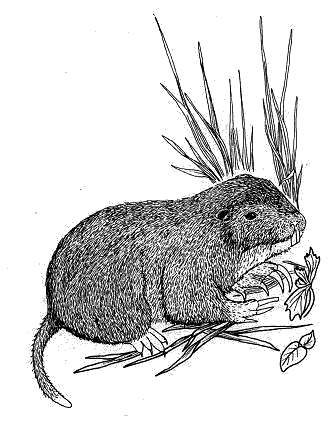 |
Gophers are also called “pocket gophers” from their habit of storing food bits and nest materials into enlarged fur-lined pouches on each cheek. The word “gopher” itself comes from the French gaufre de miel, or honeycomb, and probably refers to the effects of their compulsive tunneling. There are about 30 species of gophers. Three common species include the Plains gopher (Geomys bursarius) from the Plains states; the Valley or Botta’s gopher (Thomomys bottae), of California and the southwest; and the Northern pocket gopher (T. talpoides.), of the Northwest, Montana, and the Dakotas.
The average gopher is 6 to 12 inches long and is a lean mean digging and eating machine. He’s well equipped for his main task in life, with a stout, thick-set body, short legs, huge front claws, small eyes and ears set on a massive skull, and large, curved incisor teeth. (Moles have no visible ears and no cheek pouches.) The thick fur is usually brown, and resists wetting. The tail is provided with sensitive nerve endings. Gophers are violently antisocial but when they are in the mood they produce 1 to 2 litters a year, with 3 or 4 offspring per litter. The young must scatter to dig their own tunnels as soon as the are able. Gophers live to about 3 years of age if they manage to escape their numerous natural enemies.
Distinguishing from other similar animals
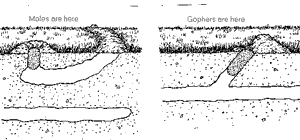 |
Are They Moles or Gophers?:-:Mole tunnels differ from those of gophers in one critical way. From the main tunnel, moles push a short shaft straight up to the surface. As moles push soil out through this hole, the soil forms a nearly circular mound, which may contain "ripple marks" or concentric circles of dirt. Gophers construct a short inclined tunnel to the surface, and as they push the dirt out, successive loads of soil are deposited in only one direction, so that the soil mound is offset at an angle from the hole. This is an important diagnostic point, because gophers are more serious pests than moles.
Gopher’s Feeding Habits
Unlike moles, which are primarily carnivorous, gophers are strict vegetarians. They tunnel near the soil surface to eat bulbs, grasses, roots, seeds, tubers, and sometimes tree bark. They dig much deeper for shelter, with side chambers hollowed out for nests, food storage, and toileting. Gophers can dig about 150 feet of tunnels in a day’s search for food, and sometimes they will come up and forage on the surface. In snowy regions gophers may tunnel through packed snow to feed on plant materials. They will eat about 75 percent of their own weight in plant matter a day. Gophers are active all year long if conditions permit. They are most busy in spring and fall, and do not hibernate.
Plants Vulnerable to Gopher
Gophers eat the underground parts of many garden crops (carrots, sweet potatoes, and peas are favorites), and just about any other root, bulb, and tuber, plus grasses and seeds. They can damage lawns, flowers, and vines, and they can girdle and kill young fruit trees. Their mounds sometimes smother small plants.
Plants Resistant to Gopher
If a gopher is hungry enough it will eat anything, but there are a few plants that seem to be lowest on their menu. Here is an anecdotal list:
Clivia (Clivia species)
Coral bells (Heuchera species)
Eucalyptus (Eucalyptus species)
Foxglove (Digitalis species)
Garlic (Allium sativum)
Holly (Ilex species)
Lantana (Lantana species)
Lavender (Lavandula species)
Natal plum (Carissa grandifolia)
Oleander (Nerium oleander)
Shasta daisy (Chrysanthemum x superbum)
Squills (Scilla species)
