
 |
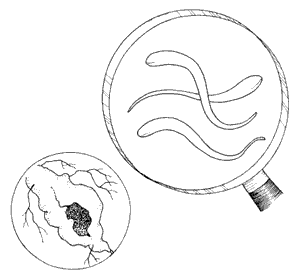
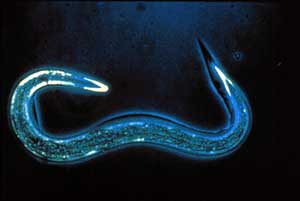
Nematodes are whitish, translucent, wormlike minuscule creatures barely visible to the naked eye, 1/125 - 1/20 inch long. Their bodies are tapered at each end, unsegmented, and covered with a tough cuticle.
Most nematodes are innocuous, living out their lives in fresh and salt water and in soil. Some are beneficial, parasitizing a long list of pest insects. A relative handful are important plant pests.
Pest Nematodes attack all plant parts--stems, leaves, buds, roots, bulbs and corms. A few cause galls or other distinctive symptoms on roots or leaves. Others produce leaf discoloration, stunting, or dieback that is frequently blamed at first on other pests or plant diseases. Nematodes prefer warm areas and are serious problems in sandy or loam soils, and, in some cases, in heavy soils as well.
 |
A common example of a pest nematode is the root-knot nematode (Meloidogyne spp.) The worms enter plant roots soon after hatching in the surrounding soil. They inject saliva into wounded tissues as they feed, introducing toxins and bacteria that cause plant tissues to rot. Cells at that point enlarge grotesquely, forming a protective and nourishing gall (the root knot) around the worm, which interferes with nutrient transport.
Most Obvious Symptoms
Plants infested with nematodes look sickly, wilted, or stunted, with yellowed or bronzed foliage. They decline slowly and die. Root systems are poorly developed, even partially decayed. Bulbs and corms are damaged. Roots have knots or galls on them. Effects of nematode activity are most apparent in hot weather, when plants recover poorly from the heat.
Emergent Times For Nematodes
Nematodes are always present in soil
