
Scout For Slugs And Snails
The best way to control pests is to start before they become very numerous. Be observant and spot early arrivals. Because slugs and snails feed only at night and hide in moist, dark places during the day it is hard to see them unless you know where to look. They are most active from 2 hours after sunset until 2 hours before sunrise. If you go out about 3 hours after dusk with a flashlight, you can often see their slimy trails which lead to the pests themselves. The easiest way to confirm the presence of slugs and snails is to put a flat board or the rind of an eaten grapefruit or cantaloupe, hollow side down, on bare, moistened soil out in the area where you suspect their presence. Then check underneath at mid-morning the next day. If you have a serious slug or snail problem, a few of the culprits will be lurking there. Another technique is to set out one or two slug traps to confirm that the culprits are indeed in your garden. We have a number of slug traps available in Yardener's Tool Shed; click here
Hand Picking
Hand picking individual slugs can make a sizable dent in the slug or snail infestation right away, particularly if combined with trapping. The best time to do this is at night. Use a flashlight and wear gloves or use tweezers and pluck them from leaf surfaces and (drop)them a can half full of soapy water. Remove any mucous on your hands or clothes by rinsing them in a vinegar solution.
Alternate ways to kill slugs which do not require that you handle them are sprinkling them with table salt or spraying them with a dilute vinegar spray. Mix cider vinegar 1:1 with water and put it in a hand pump sprayer. Spritz each slug individually. Both salt and vinegar can harm plants, so use them sparingly. Because slugs don’t necessarily go out every single night to feed, follow up with another round of handpicking a few nights later.
Trapping Slugs
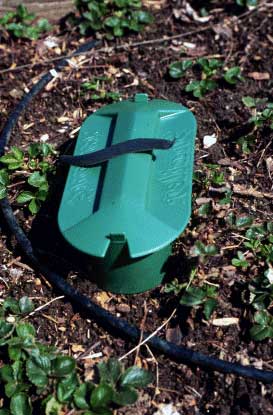 |
Beer Trap - Bait shallow pans or commercial slug traps, set in the soil with stale beer or with 1 teaspoon of baking yeast in 3 ounces of water to attract slugs. Attracted to the yeast, they fall in and drown. Replace the bait every few days, or after a rain if the trap has no cover.
For slug monitoring, place traps right in planted areas. For slug control, place traps just outside the planted areas where they are at work. Slugs will travel some distance for beer bait, and you do not want to lure more into your beds. Use more than one trap if control is your goal, maybe 1 trap for every 10 square feet.
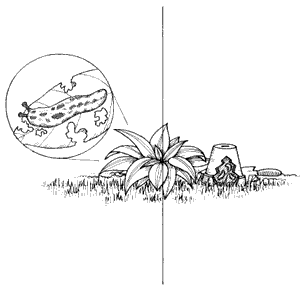 |
Cover Traps - Create a cool, shady daytime environment as cover trap for slugs. They are attracted to overturned clay flower pots, flat stones, or boards for shelter during daylight hours. Place a flower pot trap on the north, or shady, side of a vulnerable plant and tip up one edge so that slugs can easily crawl underneath. Lift up cover traps daily to check for early arrivals. It is best to visit these cover traps twice a day to collect victims.
We have a number of slug traps available in Yardener's Tool Shed; click here
Using Barriers
A good way to control slug damage is to prevent access to target plants. A number of slug barrier techniques and products do just this.
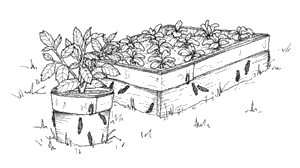 |
Copper Flashing - A two inch strip of copper flashing material is an effective slug barrier. Mounted on the edges of boxed raised beds it carries a very mild electrical charge which is stimulated by contact with the slug’s slimy mucus. While humans can't detect it, slugs can, and they re repelled. Tack a 2-inch strip of copper flashing about 1 inch from the top of the boards surrounding each boxed bed. Other copper flashing products also protect containerized trees and shrubs from slugs and snails. Go to Yardener's Tool Shed for copper flashing products
Mineral Barriers - Diatomaceous earth (DE), aluminum sulfate and builder’s sharp sand are effective barriers for slugs. Sprinkle one of these materials on the ground around each vulnerable plant or group of plants so slugs are forced to cross it to eat. The DE cuts their skin, the aluminum sulfate desiccates it, and sand irritates it. Temporary solutions at best, these barriers must be renewed after a rain.
Crushed Egg Shells - Save your egg shells and crush them so the particles are about the size of confetti. Spreading egg shells around the area where you are having slug damage is effective for some folks. The sharp edges cut the slug's tummy. Unlike the diatomaceious earth recommended above, egg shells do not need to be renewed after a rain. At the same time, the effectiveness of the barrier increases as you add more layers of crushed egg shells over time. You get a side benefit of adding Calcium to your soil as the egg shells slowly decompose.
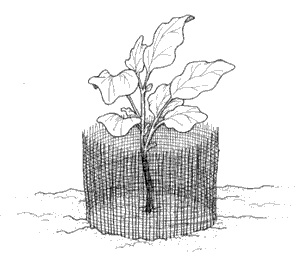 |
Protective Collars - Protect seedlings with small “collars” of window screen material. Cut the wire mesh into 8-inch squares, cutting in from one edge to cut a small hole in the center for the plant stem. Unravel several rows of wire at the top edge, to create a sharp, piercing barrier. Place a collar around each seedling at planting time. Remove them when plants are established and can fend off slugs on their ow
The Role Of Mulch
While it may seem as if routine use of mulch in areas where plants are plagued with slug problems encourages them because they love the kind of moist, acidic, woodsy environment that mulch creates, mulch actually contributes to the solution of slug problems. Yes, slugs like to hide under mulch during the day. However, many of their most effective predators such as spiders, rove beetles, centipedes, firefly larvae, ground beetles, and soldier beetles love to hunt there. Also, these beneficial predators will devour most slug eggs laid in mulch before they have a chance to hatch.
To hedge your bet, if you have access to pine needles, mulch the most vulnerable plants such as hosta with them. Slugs don’t seem to like to hide in or walk across pine needles. Also you might delay spreading summer mulch until daytime temperatures exceed 70° F, when the slugs are supposed to slow down their activity, before putting mulch down.
