
 |
| ©Bayer Corporation |
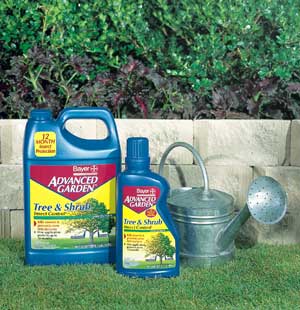
Bayer Advanced Garden Tree & Shrub Insect Control is a revolutionary new product that offers 12 months of systemic control of insects, and does not require spraying. The user simply mixes and pours it, like a drench, around the tree or shrub base.
It contains imidacloprid (called Merit), which provides broad-spectrum systemic control, and is effective at very low use rates for killing insects.
What insects does this product control?
| Insects Controlled | ||
|---|---|---|
| Aphids | Leafminers | Leaf-feeding Beetles |
| Adelgids | Birch Leafminer | Japanese Beetle |
| Scales | Royal palm bugs | Elm leaf beetles |
| Psyllids | Pine tip moth larvae | Viburnum leaf beetles |
| Lacebugs | Sawfly larvae | Black vine weevil larvae |
| Mealybugs | Flat headed borers | Roundheaded borers |
| Leafhoppers | Bronze Birch borers | Eucalyptus longhorned borers |
| Thrips | Alder borers | Whiteflies |
Recently added is the Emerald Ash Borer.
What insects this product does not control?
Some of the ornamental pests that it will not control include: mites, nematodes, gypsy moth, fall armyworm, eastern tent caterpillar.
Benefits Bayer Advanced Garden Tree & Shrub Insect Control
| Benefits of this Product | |
|---|---|
| FEATURE | BENEFITS |
| One Application per Year | 12 Month Insect Protection with One application |
| Soil Treatments | No SPRAYING, just mix and pour, as a drench. |
| |
Can be applied anytime of the year except when the ground is frozen, or water logged. |
| |
Soil treatments eliminate spray drift |
| Broad-Spectrum Insect Control | Controls all major listed insect pests of trees and shrubs |
| Systemic Action | Reduces impact on beneficial foliage inhabiting organisms, |
| |
Imparts systemic Protection throughout the plant. |
| No phytotoxicity | Safe to Trees & Shrubs |
| New Chemistry | Provides an ingredient that insect pests are not tolerant to. |
| Low Use Rates | Less insecticide in the environment. |
| Good Ecological Profile | Low toxicity to mammals, birds, fish, and other non-target organisms. |
| |
|
Why Use Bayer Tree and Shrub Insect Control?
Bayer Tree and Shrub products offer year-long protection against harmful insects. With its systemic formula, the solution works from the inside out — keeping pests away without spraying. Whether you're using Bayer Tree and Shrub Protect and Feed or the systemic version, your trees and shrubs stay healthier with fewer infestations.
This makes Bayer Tree and Shrub Insect Control ideal for gardeners seeking long-term protection from common pests like Japanese beetles, borers, and leafminers.
When to Apply Bayer Advanced Tree and Shrub Protect and Feed
You can apply Bayer Advanced Tree and Shrub Protect and Feed nearly any time of year — except when the ground is frozen or waterlogged. For spring pests like aphids and birch leafminers, late fall or early spring works best. For insects that appear in summer, early spring applications are most effective.
Best Timing:
-
Late Fall – For early-season pests
-
Early Spring – For season-long protection
-
Avoid applying during frozen or overly wet soil conditions
How This Product Compares to Other Tree Insect Control Options
Many gardeners consider multiple tree insect control solutions, but not all offer the same effectiveness. Here's how Bayer compares:
-
Unlike general tree insect killers, this product offers systemic protection for 12 months.
-
Compared to traditional sprays or dusts, it penetrates the root system and protects the plant from the inside out.
-
Many tree and shrub insect control options require frequent applications — Bayer only needs one per year.
-
It's a low-impact insecticide for trees that also helps reduce environmental exposure.
Bayer Tree Care Product Line Overview
Bayer offers several powerful solutions under its Tree and Shrub product family:
-
Bayer 12-Month Tree and Shrub Protect and Feed
Combines long-term pest control with slow-release nutrients to support tree and shrub health. -
Bayer Tree and Shrub Insect Control
A pure insecticide option for those looking to eliminate pests without feeding. -
Bayer Systemic Tree and Shrub Formula
Offers deep-root systemic protection without the need to spray — especially effective against beetles and borers.
While not marketed as a Bayer tree fertilizer, many users appreciate the feeding benefits built into the “Protect and Feed” variant.
🔗 Related Uses and Recommendations
If you're researching options like tree insect control or insecticide for trees, Bayer Tree and Shrub solutions should be at the top of your list. Whether you're protecting roses, azaleas, or a 40' hemlock, these products provide consistent results year-round.
And for those looking specifically for a tree insect killer, Bayer Systemic Tree and Shrub Insect Control delivers high-performance pest defense with minimal effort.
Frequently Asked Questions (FAQ)
How do you apply product?
For trees, mix 1oz of Bayer Advanced Tree & Shrub Insect Control per 1 inch of distance around the tree and place this amount in 1 gallon of water. For shrubs, use 3 oz of the product per foot of height mixed in 1 gallon of water.
For example:
If a tree measure 20 inches around then put 20 oz of the product in 1 gallon of water and pour around the base of the tree.
If you have a 2-foot azalea, then place 6 oz of THIS PRODUCT in 1 gallon of water and pour around the base of the plant.
2.When is the best time of the year to apply the product?
You can apply anytime!
Late fall applications may be most appropriate for early spring pests such as birch leafminers, aphids, etc. For pests that occur later in the season, late fall or early spring applications are effective.
Do NOT apply this product when the ground is frozen or waterlogged. If the ground is frozen or waterlogged, the material can not soak into the ground and get to the roots.
Does the size of the tree make a difference?
Yes! The use rate is 1 ounce of the product per inch of distance around the tree trunk.
Can I apply this to my fruit trees?
No! The product in NOT registered or labeled for application to fruit trees.
I have a 40' Hemlock tree. When do I apply to control the hemlock woolly adelgid?
Soil treatments should be made when the soil is moist and not frozen or waterlogged.
Fall to early winter (late August to early December) and spring to early summer (mid-March to mid-June) are optimal periods for making soil applications for the hemlock woolly adelgid.
Can I use this on rose bushes?
Yes, use 3 oz of this product per foot of height, put into 1 gallon of water, and pour around the base of the plant.
Does weather conditions affect the products efficacy? Yes, it can. Uptake of this product is best when the plant is vigorously growing; thus, during periods when the soil is frozen or during drought conditions (or when transpiration is very low), uptake will most likely be reduced.
Can a drought have impact?
If a drought is occurring during a period in which an application is desired, it is recommended to water the plants to be treated well before making the soil application.
When should I apply Bayer Advanced Tree and Shrub Insect Control?
For optimal results, apply Bayer Advanced Tree and Shrub Insect Control in early spring or late fall when the soil is moist but not frozen or waterlogged. These conditions facilitate the product's absorption through the roots, ensuring effective systemic protection throughout the plant.
Early spring applications are ideal for combating pests like aphids and birch leafminers that emerge as the growing season begins. Late fall treatments can help protect against pests that appear in early spring, providing a proactive defense. Avoid applying the product during periods of drought or heavy rainfall, as extreme soil conditions can hinder its effectiveness.
By timing your application appropriately, you can ensure your trees and shrubs receive year-long protection against a broad spectrum of insect pests.
Is this a fertilizer or just an insecticide?
Bayer Advanced offers both standalone insecticides and combination products that include fertilizer.
-
Bayer Advanced Tree and Shrub Insect Control: This product is solely an insecticide. It provides systemic protection against various pests but does not contain any fertilizing components.
-
Bayer Advanced Tree and Shrub Protect and Feed: This is a dual-action product that serves as both an insecticide and a fertilizer. It offers 12-month systemic insect protection and includes a slow-release fertilizer with a 2-1-1 NPK ratio, promoting plant health and growth.
Therefore, if you're seeking both pest control and nutritional support for your trees and shrubs, the "Protect and Feed" variant is the appropriate choice.
Will this product work on Japanese beetles and emerald ash borers?
Yes, Bayer Advanced Tree and Shrub Insect Control is highly effective against both Japanese beetles and emerald ash borers.
Japanese Beetles
This product targets adult Japanese beetles, which are known for feeding on the foliage and flowers of over 300 plant species. By applying the treatment, you can protect your trees and shrubs from the extensive damage these beetles cause during their active months.
Emerald Ash Borers
Emerald ash borers are invasive pests that attack ash trees by burrowing into the bark and disrupting the tree's ability to transport water and nutrients. Bayer Advanced Tree and Shrub Insect Control provides systemic protection that helps prevent infestations and protects the health of your ash trees
For optimal results, apply the product in early spring or late fall when the soil is moist but not frozen or waterlogged. This timing ensures effective uptake by the roots, providing long-lasting protection throughout the growing season.
By incorporating this treatment into your tree and shrub care routine, you can safeguard your landscape from these destructive pests.
Can I use this on my fruit trees?
No, Bayer Advanced Tree and Shrub Insect Control is not labeled for use on fruit or nut trees intended for consumption. The product is formulated for ornamental trees and shrubs and is only approved for non-bearing fruit and nut trees—those that will not produce edible fruit or nuts for at least 12 months after application. Applying this product to fruit-bearing trees could result in pesticide residues on the edible parts, posing potential health risks. Always adhere to label instructions to ensure safety and compliance with regulations.
Is Bayer Tree and Shrub safe for all trees and shrubs?
Yes, when used according to the label directions, Bayer Advanced Tree and Shrub Insect Control is safe for a wide range of ornamental trees and shrubs. It provides systemic protection against various pests without harming the plants. However, it's crucial to follow the recommended application rates and methods to avoid potential phytotoxicity or environmental harm. Do not apply to stressed plants or during extreme weather conditions, and ensure the product is not used on prohibited species as specified on the label.
What’s the use rate for larger trees?
For effective pest control, the application rate depends on the size of the tree or shrub:
-
Trees: Measure the circumference of the tree trunk at approximately 4.5 feet above the ground. Apply 1 ounce of product per inch of trunk circumference, mixed in 1 gallon of water.
Example: For a tree with a 20-inch circumference, mix 20 ounces of the product in 1 gallon of water and apply evenly around the base of the tree.
-
Shrubs: Measure the height of the shrub. Apply 3 ounces of product per foot of shrub height, mixed in 1 gallon of water.
Example: For a 2-foot-tall shrub, mix 6 ounces of the product in 1 gallon of water and apply around the base.
Ensure the soil is moist but not saturated or frozen at the time of application to facilitate proper absorption. Avoid applying during drought conditions or when heavy rainfall is expected.
Can too much rain impact the product efficacy?
No! After the product is applied too much rain will not reduce efficacy, and the systemic action can’t be washed
22. Will this product have any impact on soil insects such as cutworms, earwigs, and termites when applied as directed? This product will suppress cutworm populations (provide approximately 60% control), it is not likely to have any effect on earwigs, Imidacloprid is an effective termiticide product and is sold under the trademark PremiseÒ on the professional side. As the product label is written, it is not registered for any of these pests.
For more information about this product go to www.bayeradvancedgarden.com
