
 |
In short:
• Hostas are true perennials, they return every year in USDA zones 3–9, not annuals you replant each season.
• Despite the "plantain lily" nickname, hostas aren't true lilies they're in the asparagus family (Asparagaceae) and grown mainly for foliage, not flowers.
• Mature clumps range from about 4 inches to 5 feet wide depending on the variety, with lavender or white funnel-shaped flowers in mid-to-late summer.
• Hosta foliage dies back to the ground each fall they aren't evergreen, but the root crown survives winter and resprouts in spring.
Is a Hosta a Perennial or an Annual?
A hosta is a perennial, not an annual. Once planted, the same root system survives winter underground and sends up new foliage every spring, you never need to replant it. Hostas are hardy in USDA zones 3 through 9, which covers nearly all of the continental United States, and the plant relies on a cold winter dormancy period to grow well the following year. Each spring the clump also gets a little larger than the year before, since hostas spread slowly by expanding their root crown rather than reseeding themselves. In fall, the foliage yellows and collapses to the ground with the first hard frost, but this dieback is normal winter dormancy, not the plant dying new shoots called "pips" emerge from the same crown the following spring. For help keeping a mature clump healthy through that yearly cycle, see Caring For Hosta.
Hosta vs. True Lily: Are They the Same Plant?
Hostas are commonly called plantain lilies, but they aren't true lilies. True lilies belong to the genus Lilium and grow from a bulb, while hostas belong to the genus Hosta in the Asparagaceae (asparagus) family and grow from a fibrous root crown, not a bulb. The "lily" nickname comes from the shape of the hosta's flowers, which do resemble small lilies, but the two plants aren't botanically related and are grown for very different reasons true lilies are prized for their flowers, while hostas are grown almost entirely for their foliage, with the summer blooms treated as a bonus. If you're shopping for hostas, look for the genus Hosta rather than Lilium, and expect them to be sold by cultivar name like "Frances Williams" or "Blue Angel" rather than a single common name. See Choosing Hosta for how to pick a cultivar for your yard.
Hostas, also called Plantain Lilies, are a home landscape mainstay. They are perennial, reappearing dependably every spring to serve as groundcovers and foliage plants for shady areas and around trees and shrubs. They are versatile, low-maintenance plants. The many attractive varieties of hosta have flowers as well. Although not as ornamental as the foliage, the flowers add a pretty touch of color for a short time in summer to brighten shaded spots. Once established in a comfortable site, hostas thrive for many years with minimal attention.
Size
Various types of hostas grow in mounded leafy clumps from about 1/2 to 1 1/2 feet tall. Their flower stalks typically extend to 2 1/2 feet. Undivided, healthy, mature plants can spread as wide as 5 feet, but many homeowners divide their hosta clumps periodically to maintain them at 18 to 24 inches wide. The smaller hostas, Hosta venusta and its hybrids, are miniatures that grow anywhere from 4 to 12 inches tall.
 |
Foliage
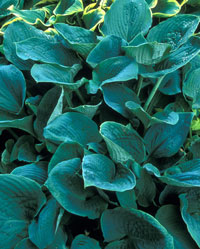
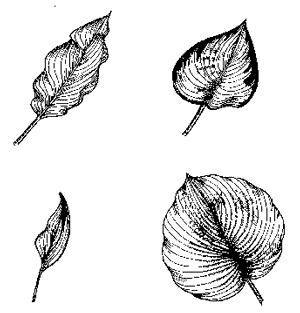
Hostas are valued for their dramatic foliage. Leaves of juvenile plants often do not show the shape and texture that they will have as adults. Different varieties offer leaves that range from pale green to medium green to yellow-green and even blue. Some are variegated, having striking yellow or white edges. Leaves are typically highly textured, often featuring prominent ribs or veins. They may also have shiny or waxy surfaces.
Individual leaves of the various hostas may measure from 3 to 15 inches long and from 1 1/2 to 6 inches wide. The smallest may have an area of two square inches, while the largest leaves may be over 1 square foot in area. Some are more sword-shaped, while others are elliptical or spoon shaped. Hosta foliage turns yellow, then mushy, then dies back to the soil when frost arrives.
Flowers
Hosta flowers bloom in mid to late summer or early fall, depending on the variety. They appear along stems that arch above the clump of leaves. They are funnel-shaped, typically about 2 inches long and usually lavender. However, the plantain lily’s flowers are white and a spectacular 4 to 5 inches long with a lovely fragrance. When they fade, green seed pods appear in their place on the stalks. The stalks should be cut off at this time.
